

Detailed Guide to Fine-Tuning 3D Generation Models
Hugging Face has published scripts and containers for fine-tuning TRELLIS.2 on custom 3D data. The process can be run locally or via the Hugging Face Jobs cloud service.
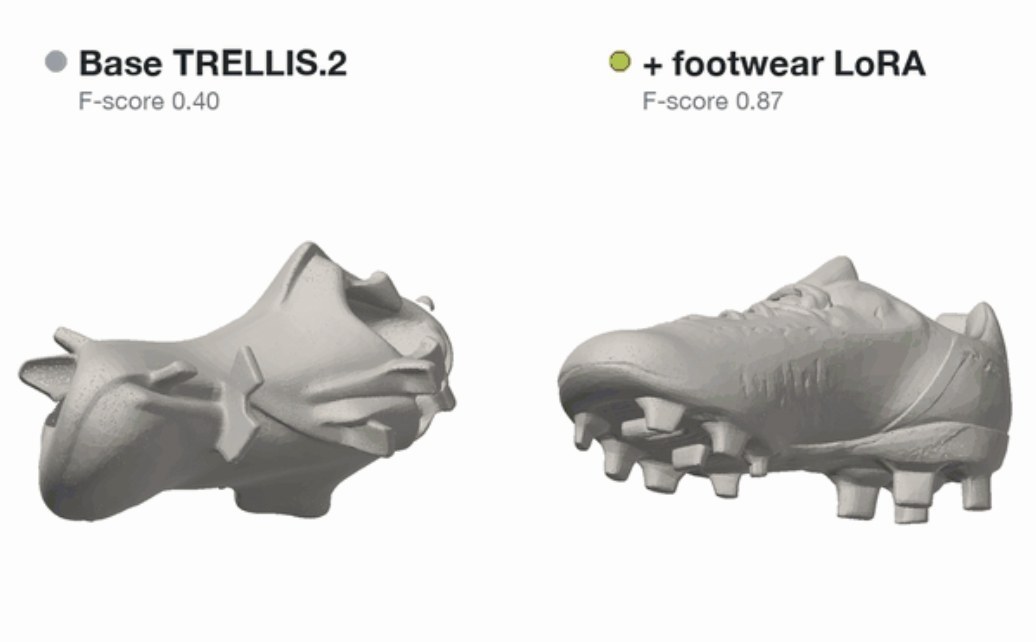
The materials are designed for developers who need to adapt a general-purpose 3D model to a specific type of object. As an example, the authors improved the generation of footwear: the original version usually correctly conveyed the appearance but made errors in the sole geometry.
For the experiment, 188 objects from the Google Scanned Objects dataset were used. The scripts first convert GLB or OBJ models into TRELLIS.2's internal representations and generate training images. Blender automatically renders 16 viewpoints for each object, after which the prepared dataset can be reused in different runs.
Fine-tuning is based on LoRA—a method in which the original model weights are frozen, and small adapters are trained. This reduces memory and computational requirements compared to full fine-tuning. In the experiment, adapters were added only to two components responsible for the object's shape and geometry. The component that creates materials and textures was left unchanged: the dataset did not include separate material maps, and the task focused specifically on shape.

Two Docker containers are provided for data preparation and training. They can be launched via Hugging Face Jobs or on a user's own GPU machine. Preparing a dataset of 188 objects took about 1 hour on an a100-large job. Before starting, a Hugging Face token, access to the private DINOv3 model, and user-uploaded 3D models in the Hub are required.
In the general configuration, approximately 9.3 million adapter parameters are trained for the two target components. The authors also explain script settings, the order of container launches, and methods for uploading the finished adapters to the Hub.